The Hand on the Coffin
- Janne Salo

- Feb 3
- 12 min read
Updated: Mar 14
A Moment of Loss 3000 Years Ago Reaches Forward: Not For Remembrance, But for Company.

LUXOR, EGYPT
Amenemonet's tomb, TT277, is tucked into the abandoned village of Qurnet Murai on Luxor’s West Bank— where the asphalt thins out and donkeys set the speed limit, a quiet fold in a hill of tombs staring back at modern Luxor.
You don’t come here expecting grandeur. No giants. No polished hieroglyphs. Just a slope of dust behind the ruins of a king’s forgotten temple, a cracked entryway yawning from the heat, and the promise of a dead priest who wanted to live forever.
A Ghost Town Over the Necropolis at Qurnet Murai
It doesn’t look like much at first. A square concrete enclosure with steps dropping to a padlocked metal gate.
From a distance, it could be a bunker.
To the right, a board on twin metal poles announces in odd, officious fonts: “TT277 AMENEMONET — Divine Father (Ptah-Sokar) Chapel.” On the left, an identical sign reads for his neighbor in death: “TT278 AMENEMHAB — Herdsman of Amun-Re."
Up the slope, deserted houses bake in the sun—turquoise doors, plaster peeling in plates. They sit crooked at the foot of a hill carved with tombs older than any god anyone still worships. Qurnet Murai sits in the Theban necropolis — the afterlife is local.
Walking Among Echoes at Qurnet Murai
People once lived here because it was free, because no one else wanted the land, because the dead didn't complain. The tombs were pantries, tool sheds, sometimes bedrooms in summer. A man with a lantern led Germans or Japanese through the dust for a few piastres. Another shaved “antikas” from sarcophagi and sold the past by the shard. Some went into the hills and came back days later with gold teeth or a mummified hand with the wrappings still on. It wasn’t a village so much as a compromise — between poverty and inheritance, between what was sacred and what could be sold.
But stand at the edge of Amenemonet's tomb. Let your eyes adjust. Let the heat settle around your shoulders. The air down here changes—denser, quieter, as if it remembers names. The descent is shallow. You're not scrambling; you're being drawn — bit by bit — into a world that doesn’t quite belong to us. You step down into something built not for spectacle, but for function. For work. For crossing.

A Room That Remembers
Amenemonet served at the temple of Amenhotep III - as a priest - pouring libations and intoning sacred texts — a Divine Father of Ptah-Sokar. His wife was a Chantress of Amun. He had a handful of children and a job that required white linen and patience. In life, he honored the divine. In death, he trusted it would welcome him.
His tomb opens with a shrug: irregular, narrow, smudged by time and rain. But inside, it tells a story better than most travel writers ever manage. It tells you what it means to let go.
A Life, A Death, A Passage
Here, the walls speak. Not in metaphor, but in motion. You stand in this small, chalk-dry chamber, and around you, the story of a soul unspools like a remembered dream: a life, a death, a passage. But what stuns isn’t the symbolism—it’s the intensity. These aren’t just scenes. They’re moments. Carried across 3,000 years.
The Soul’s Migration: From Breath to Light
Animated pictures pulse with urgency. Boats ride over fields of reeds, carrying Amenoment’s coffin downstream — not as metaphor, but as migration: the soul moving toward the source. The soul on its journey, toward a distant sun where breath is given back.
The Shortlist of What Makes a Life Feel Like Life
There is a scene of livestock, of offerings stacked like memory — bread, beer, onions, joints of meat, bouquets. Not a kitchen, but a kind of prayer. And there are others: scenes of labor, of devotion, of the invisible ties between the living and the dead.
On limited plaster they tried to say everything worth saying about contentment — the taste on the tongue, the sound in the ear, the task that marked your worth, the voices that remembered you, the unseen presences you bargained with in the dark — the shortlist of what makes a life feel like life.
The Ritual Ache That Nourishes The Spirit Across the Veil
Scholars call it “nourishing the Ka (the vital force),” which is accurate in detail, but misses the intimacy — the love, the longing, the belief that shaped it. For example, the mourners who wail with lifted hands. The musicians who play for the dead—lyres, clapping, rhythm and grief in the same beat. The women tear their hair, press dust to their heads, bend low with ritual ache. All of it meant to nourish a spirit across the veil.
And behind it all: order. Stillness. Sacred repetition.
The World is Just a Side Door
This is not a tomb for ending. It’s a staging ground for return. You don’t just see Amenemonet’s life — you feel it press outward from the walls. These aren’t decorations; they’re instructions. Testimony. Echoes of one man’s certainty that this world is only a passage—just a side door to something more real. Earth was the echo; the afterlife, the voice. He prepared not for burial but for release.
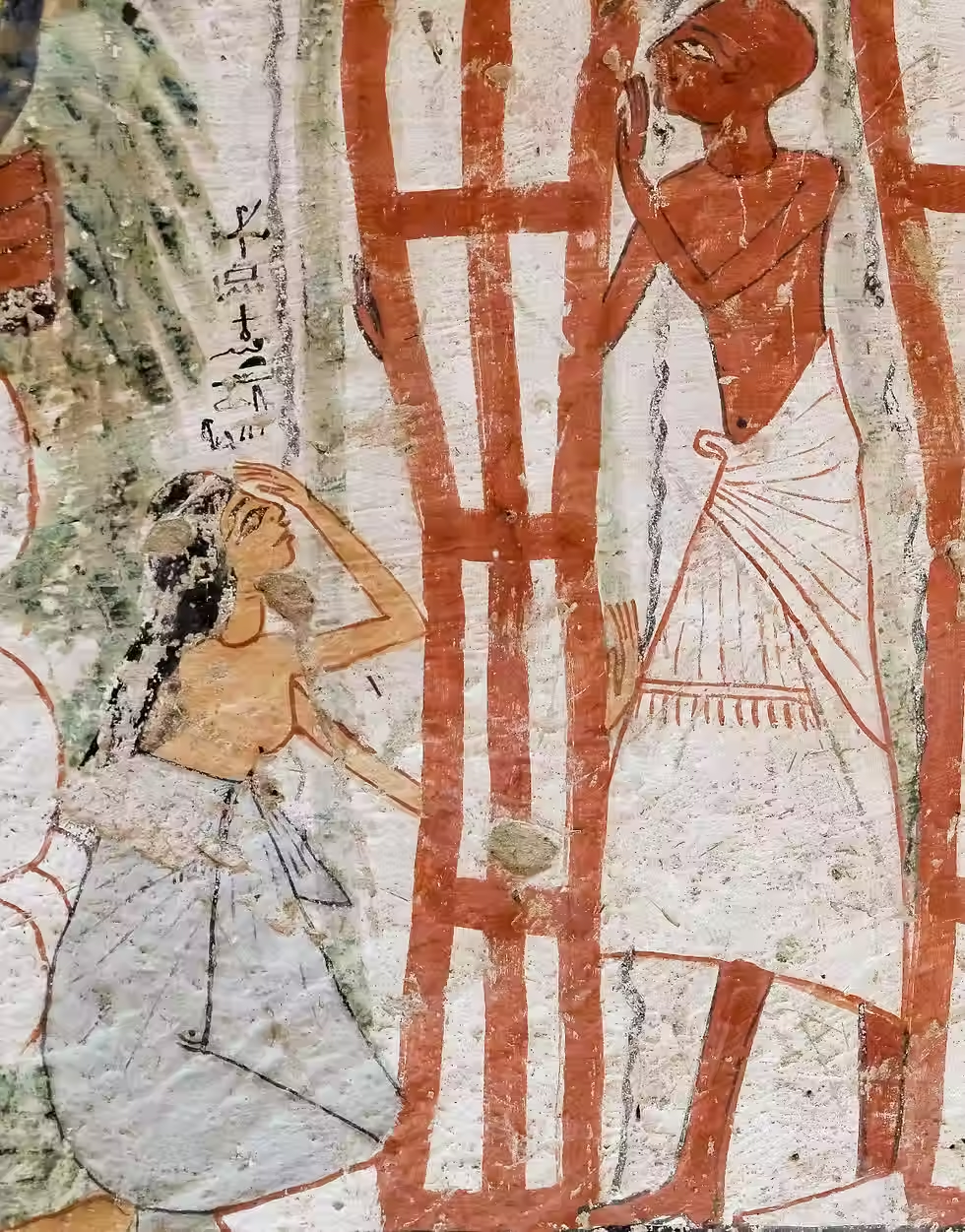
The Hand That Holds The Dust
The room is small.
There’s too much in it—dust, heat and the ache of the day that won’t set.
His wife kneels by the coffin. Weeping and sobbing.
She throws dust onto her head in mourning.
The kind of dust that means, I am still here.
The kind of dust you toss when you’ve run out of language.
Some sorrows need soil. Some prayers need grit.
She covers herself with the world so she can go on belonging to it.
With the other hand, she clings to the coffin’s foot like she’s holding the last solid edge of her world.
She doesn’t beg. She doesn’t collapse. She touches. Just that.
Her grip says what words can’t.
I knew you. You were here. You matter.
Wailing and worship, panic and poise, side by side.
This is how life actually holds.
The priest at the head doesn’t interfere.
He holds his pose.
Together they form a bracket.
The living keep vigil on either side of the dead.
The upright coffin is not only a container for the dead; it is a vertical put back into a broken day. Something has fallen—someone—and the rites answer by raising.

The Honest Grip: Love as an Act of Staying
The world doesn’t stop—it braces.
The wife’s grip on the coffin’s foot is one of the most honest images of love we have.
Love as staying where one’s hands can still say “stay with me while we change.”
Release does not mean letting go of love. It means loosening the grip of terror so love can move again. Terror clutches; love circulates.
The Volume of Grief: Professional Mourners and Ritual Cries
The professional mourners take their shift.
Thin linen, bare shoulders, hair loose, hands lifted in despair.
They don’t claim kin; they provide volume.
Their palms set the beat, their cries keep the name in circulation.
Wailing is on the list with oil and bread.
Egypt is honest about what a passage costs.
Even the dust plays a part.
It settles with more weight.
It clings where tears have fallen.
It gives grief a body.
The dead man is being lifted.
But so are the living.
Not out of sorrow, but into it.
Into the strange, shared space where people stay long enough to bear what can’t be fixed.

The Soul Waiting At The Edge of Breath
At the edge of the frame, a yellow door glows faintly.
Dust becomes anointment.
And the soul, which has been waiting at the edge of breath, finds the opening it recognizes.
A hand is raised—a wave, or a blessing, or just a signal.
Someone saying: I made it through.
Maybe that’s the point of the whole ritual.
Not to undo death, but to get close enough to it that love has a place to land.
The Men That Carried The Weightless Light
They carry him as if he has no weight.
Four men in linen kilts move his coffin effortlessly.
Their arms do not flex.
Their backs do not bend.
The coffin floats forward as if the soul has already lightened the load.
The fifth man walks ahead, gripping a bronze-handled censer, its animal-headed end glowing in the sun. You imagine him move — slow, measured — dropping pellets of myrrh into the embers with each step, and smoke erupting in blue swells circling his head before clinging to the wood of the coffin behind him. A fragrant bridge strung between worlds, so Osiris, god of death and resurrection, might catch the scent of a soul he’s meant to welcome home.

Beneath the head of the painted corpse, the wall murmurs its dedication:
O Ka of the greatly favored one.
Priest of silence, father of holy fire.
You are awake in the Great West.
You give water to the thirsty, breath to the faint.
The words are both instruction and promise—part résumé, part plea.
The tomb painters wrote them like logistics: who receives what, who listens, who grants air to whom. Every death here was organized like a supply chain to the afterlife.
The Logistics of the Last Breath
It’s strange that no other Theban tomb shows this exact moment. Perhaps it was too ordinary, too near the bone of the ritual—four men hauling a wrapped colleague through the narrow door, a fifth waving incense, the last human breath before bureaucracy takes over. The faces are almost cheerful, the way porters can look when the hard part is clear and the road is known.
A Ledger of Prayer and Receipts
You realize that this is the same Egypt that invented receipts and prayer in the same gesture. Everything recorded, nothing wasted. Even now, after three thousand years, the wall keeps its accounts: names, offerings, duties, flame. The priest still tends his fire, the carriers still walk the narrow road toward the chamber where Amenemonet will lie decorously forever.
The Choreography of Absence
What you see is not grief but function: the body going where it should, the living doing what they must. And yet, the painted scene feels oddly current— like watching colleagues clear someone’s workspace after their funeral. It’s the same choreography we all learn when presence turns to absence.
The Afterlife Is Closer Than You Think
You stand too long in the half-light and your guide grows patient the way guides do when tourists confuse staring for understanding. A square room, a painted coffin, a human-headed bird hovering like a held breath. Amenemonet lies decorously forever and you—well, you have a flight in two days and a hotel with a pool. The world outside is heat and scooters and bottled water, but down here the noise is old silence. You’re surprised how companionable it is.

The Soul that Checks In: A Visitation Right
The Ba-bird doesn’t fly off and it doesn’t land. It keeps its distance the way you keep yours in foreign places—close enough to be changed, far enough to retreat if the scene asks too much.
Your guide mentions the formulae and the canopic precautions, and you nod, that docile nod of the traveler who would rather not confess she’s here for something she can’t photograph. The truth is simpler than the commentary: they did not want to let go, not quickly, not absolutely. They wanted a period of visitation rights—a soul that checks in, a presence that can still be reached by name. You know this wish. You’ve had it yourself, dialing numbers that no longer connect, staying in places where someone once waited for you and now does not.
Keeping the Channels Open: The Practicality of Love
The Ba circles because the living circle. You return to the house after the funeral and put the key in the door as if the old life might still be inside. You straighten a picture frame, rinse a cup. You say the name out loud and the room answers with nothing and you say it again. The Egyptians put a scene on the wall so the room would answer. They were practical that way. If love is going to survive, give it a surface, a procedure, a repetition. Put bread on the table. Burn resin. Write their name on a piece of paper. Keep the channels open. That’s all.

Heaven as an Adjacent Room
There is no royalty here, no distant promise of becoming a star. Amenemonet, a man with a job title, a household, a neighborhood. His heaven is not far; it is adjacent. The fields of eternity look suspiciously like fields. The blessed dead do ordinary things: walk, talk, fish, plow, recline with the people they miss. The transformation they seek is not escape; it is continuity. You find this reasonable, even modest, which is part of its power.
The Rituals That Make Grief Bearable
The paint flakes at the edges the way sentences do when the person who spoke them is gone. Still, you read. The hovering bird says: there is a remainder. Not everything ends when the body does. Something lingers, not as a miracle but as a practice. You think of small rituals that make grief bearable—tea set out for no one, an extra chair kept at the table, a story told in the present tense because the past feels like betrayal. Down here, you recognize the same impulse — preserved in pigment and posture. You don’t need a translator. You don’t need to know the words. You’ve seen this kind of love before. It’s how the mourners keep the language alive.
Housekeeping of the Soul: The Work of Light
Your guide clears his throat, the universal signal that it is either time to move on or tip. You take one last look because that is what you do when you travel: make last looks as if they were insurance.
The bird is still there, Amenemonet watching over his own bundle on the lion bed. While he holds his patch of air, he also does the rounds.
They’d call him an akh now—a worker of light; the ba (his soul) does the errands and keeps appointments.
Daylight visits to those he left behind.
A look at the lintel to see if the name’s been said.
A glance at the tray—bread, beer, flowers—receipts in order.
He reads the note someone slid under a bowl.
He moves like a swallow along the roofline, like a lotus over the basin.
Not haunting.
Housekeeping.
He isn’t above it like a cloud; he stays in range.
He doesn’t bless; he notices.
He nudges what can be nudged and leaves what can’t.
That’s the job now—be near without pulling the living down.
You keep that rule, and the day holds.
Up the steps, back to the sun, the corridor breathing you out like a lung. Somewhere a generator coughs. A donkey argues with its owner. The living stage its usual noisy coup against the dead. You pass vendors who have read your mind and laid out bread and beer in modern forms: crackers, soft drinks, cold water, the daily bribe against the heat. You buy something, anything, and think of how offerings persist by changing their brand names.
Loosening the Grip
At the gate you look back and do the unwise thing: you promise to remember him. Not because
he needs you—but because the Ba hovers in your chest now, testing whether something remains after the loss of the body. You don’t answer. You let the question stand. It feels right to leave one thing unresolved in a country built on the belief that death is not the end, only a passage.
You walk on. The day resumes. Heat presses the street flat. A bus exhales, a driver curses, a boy laughs too loudly at a joke you don’t hear. Somewhere under your feet, in that orderly room of paint and oath and patience, the bird keeps its station. Call it faith, or stubbornness, or good housekeeping of the soul. Call it Egypt. Here release does not mean you let go and forget. It means you loosen your grip just enough that love can move.


