Khufu's Final Secret
- Janne Salo

- Feb 14
- 10 min read
Updated: May 16
Awaiting the News of the Century!
Will they Find an Intact Burial Chamber Inside the Great Pyramid in 2026?

Something Wakes Up in the Desert
Something wakes up in the desert, and it isn’t human.
It has no heartbeat.
It does not breathe.
It has not moved in more than four thousand years.
But it wakes all the same—roused not by rattles or prayers, but by a ripple of numbers on a computer screen a world away.
Somewhere in an anonymous lab full of humming machines and burnt coffee, a monitor shows a block of stone that isn’t there.
A line of nothing, thirty meters long, running through the solid body of the Great Pyramid of Khufu.
At the end of that line, there is a door.
The Old Thing on the Edge of the City
The Great Pyramid sits where it always sits, squatting at the edge of Cairo. The city presses closer every year—apartment blocks, satellite dishes, traffic that sounds like an argument with the volume stuck on high.
The pyramid pays no attention.
Tour buses cough tourists onto the plateau. Tripods click open. People pose with their hands at the wrong angle, pretending to pinch the tip of the pyramid like it’s a party trick. Vendors call out in a dozen languages. Camels complain in their gargling voices. The air smells like dust, diesel, and hot stone.
All of this commotion runs up against the weathered sides of Khufu’s pyramid and dies there.
The structure does not care.
It has seen this kind of thing before—Roman soldiers carving their names, Arab builders hacking casing stones away to feed a hungry city, Napoleon’s men using it as a scenic backdrop for artillery practice.
It has seen not just crowds, but civilizations come and go.
What it has never seen is inside itself.
The Scan
Muon tomography sounds like something out of a science-fiction paperback you find yellowing in a secondhand shop, but it’s real enough: cosmic particles raining down from space, passing through the pyramid, leaving faint fingerprints of where stone is and where it isn’t.
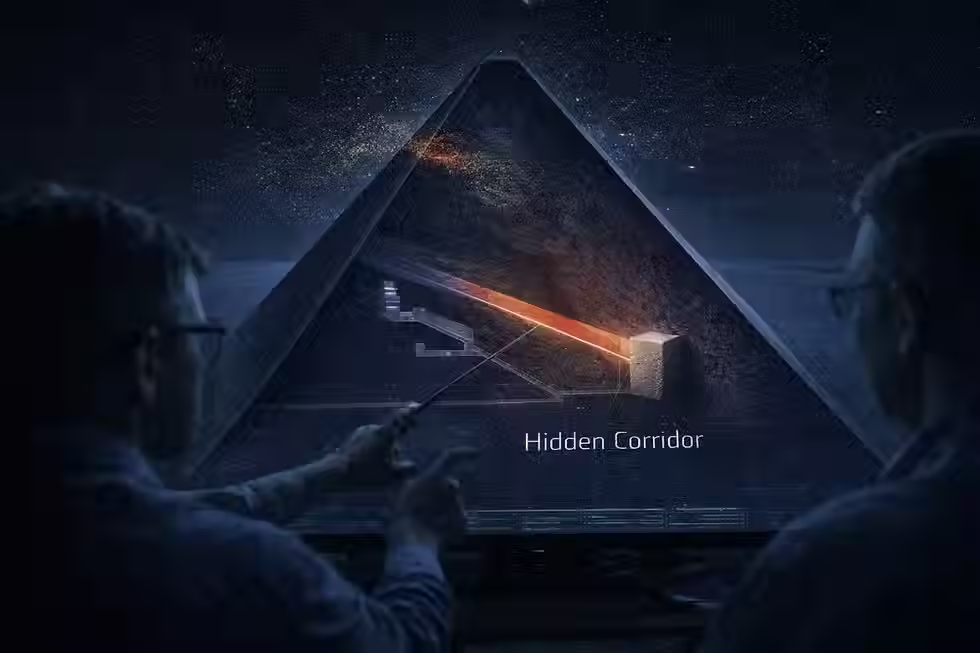

The machines measure those faint differences. Programs chew through the data.
Technicians stare at the screens until the image resolves: dense here, less dense there, a big clean gap there.
That gap is long. It is straight. It is in the wrong place.
Someone leans closer and feels the hair lift on their arms.
This isn’t some random pocket of rubble. This is a corridor.
They map it, measure it, argue about it. In all that quarreling, one quiet fact holds steady: at the end of the corridor—thirty meters in—there is a clean stop.
A blocking stone. A door that has never been opened.
Nobody heard it shut. Nobody saw the last worker step backward into the dark, wedge that block into place, and leave forever.
By the time Herodotus writes about the pyramid, this door is already an old secret.
By the time Napoleon rides out to see it, this stone has been asleep longer than any god he swears by.
But now the secret’s on a screen, and once you’ve seen it, you can’t unsee it.
That’s where the trouble starts.
Tomb, Machine, or Something Else?
Every schoolbook on earth has the same easy answer ready: the Great Pyramid is a tomb.
The problem is that the inside doesn’t play along.
There are chambers, yes—the so-called King’s Chamber, the lower Subterranean Chamber, the misnamed Queen’s Chamber, the Grand Gallery like a stone throat leading up into the heart of the thing. But no carved prayers, no spells. No instructions about the afterlife.
Later kings at Saqqara have that in spades—walls packed with words, columns of hieroglyphs stacked like legal clauses against death, what they call the Pyramid Texts, a user manual for eternity.

Khufu’s place? Bare.
There is a granite sarcophagus in the King’s Chamber, but it is empty and lidless, as if whoever was supposed to lie there never got around to it. Or never meant to.
To look at the inside of this thing is to feel the nagging sense that the labels are wrong.
Maybe “tomb” is too small a word.
Maybe this is not a box for a corpse, but a device. A machine for doing something to death.
The ancient Egyptians are not casual about the afterlife; they are methodical in a way that makes modern people seem half-asleep.
They write things down: how the soul travels, where it goes, which gates it passes, which guardians it must face.
They talk about becoming effective, changing from a simple spark of personality into something bright and powerful and permanent.
Life is the hazy hallway. Death is the real door.
The Great Pyramid is built at the threshold of that door.
If this thing is a machine, the thirty-meter hidden corridor is a part the schematics never showed.
The Door: The part of the story everyone likes is the door.
A stone door is the kind of phrase that wakes up the ten-year-old buried under every adult’s sensible surface. It smells like storybooks and curses and secret rooms. It smells like something that has been waiting.
The corridor leading to it is narrow and exact—no rough cutting, no casual void. Stone on both sides, stone above, stone below. A clean passage drawn through millions of tons of limestone, then sealed and forgotten.
At its end: that block.
Not carved with hieroglyphs. Not framed by a lintel announcing who lies on the other side. Just stone, doing what stone does best: keeping quiet.
The scientists give interviews. Some talk about relieving chambers and weight distribution. Others shake their heads at the idea of carving a thirty-meter straight run through the world’s most famous monument just to prop something up.
Meanwhile, news writers do what news writers do: shovel fuel onto the fire.
Is this Khufu’s real burial chamber?
Will we find an untouched royal mummy?
Does the Great Pyramid still hide its greatest secret?
Click. Share. Scroll.
The pyramid does not care how many likes its door gets.
But if stone could listen, that door might hear a new kind of sound after all these centuries: the buzz of millions of people wondering, worrying, hoping.
What’s behind it?
The Good Odds, the Bad Odds: Archaeologists are professional pessimists.
History has trained them that way. Every royal pyramid explored so far, from the Old Kingdom onward, is a crime scene: broken sarcophagi, scattered bones, looted walls. Gold gone; bodies tossed aside like wrapping paper. The tomb robbers were there long before the archaeologists, and they did not leave calling cards.
The Great Pyramid is a huge billboard to thieves. The old stories say even a caliph hired men to hack into it with fire and vinegar and iron, and what he found was mostly nothing.
Empty spaces. Naked stone.
If there is a hidden burial chamber inside, most experts quietly bet it was plundered when Rome was still young, or earlier. Maybe the grave goods were melted down. Maybe the papyrus rotted away when some ancient tunneling cracked the seal.
The odds are against treasure.
But odds are a slippery thing.
Nobody expected Tutankhamun’s tomb to be intact either, and yet it was. A minor king, tucked away in a corner nobody looked at closely enough—that story still shocks, a hundred years later. Not because of the gold, but because of the mistake. The way history misfiled him.
Khufu is no minor king, no misfiled pharaoh. He’s the main headline—his pyramid is the reason Giza looks the way it does in the mind’s eye.
To imagine an untouched chamber connected to him is to imagine that every thief and emperor and tomb-robber missed the real prize for four and a half thousand years.
That’s a hard story to swallow.
Not impossible, though.
Impossible things are what the pyramid has been doing since the day someone decided to start dragging stones up a slope and didn’t stop until there was a mountain where there hadn’t been one before.
The Scariest Treasure
People dream about gold.
What keeps scholars up at night isn’t gold.
It’s paper.
Well—papyrus.
They already know the Fourth Dynasty writes on it. The Wadi al-Jarf papyri, pulled out of their hiding place at the Red Sea, read like the ancient version of a spreadsheet: work crews, deliveries, the grinding logistics of moving stone for the king.
If there are work logs, there can be ritual scripts.
Before the Pyramid Texts are carved in stone generations later, there might have been prototype versions written on scrolls: spells, invocations, funeral instructions for a king whose afterlife is considered too important to risk improvisation.
Imagine a sealed space behind that stone, and inside it rolls of papyrus—dry, brittle, ink still clinging to the fibers. Words meant to be read by priests who are now nothing but names on fragments of stone.
Even one scroll would be enough. Even a fragment.
A funerary liturgy half-formed. An inventory of what was placed with the king. A drawing that looks suspiciously like a cross-section of the pyramid itself, lines and angles annotated in a hand that has not moved since the Nile valley was young.
Nothing supernatural. No curses flaring up like blowtorches in a bad movie.
Just ink. Lines. Thoughts.
Thoughts of people who built a mountain to answer the question what happens when you die?
That is treasure.
And it’s the kind of treasure that makes the world of the living tilt, just a little, on its axis.
Emptiness Is Not Nothing
Of course, there’s the other possibility.
The robot goes in, the camera feed flickers, and the world watches with the kind of breathless attention it usually reserves for championship games and rocket launches. The picture steadies.
And there is…nothing much.
Stone. Dust. A cramped pocket that looks more like an architectural shrug than a secret.
People will be quick to say it’s a disappointment. No mummy, no trove, no papyrus library. The memes will be merciless: forty-five centuries of waiting for an empty closet.
But emptiness is not nothing.
An empty space in the right place can shout louder than a treasure room.
If the cavity beyond the door is bare, that fact alone says something sharp: the Great Pyramid is not hiding a corpse. Maybe it never did.
Maybe the real burial is somewhere else entirely. Maybe the king’s body was always meant to lie in one place while his transformation was staged in another. Maybe the whole interior system—known passages, unknown corridors, blocked shafts—is ritual architecture: a map carved out of negative space.
In that reading, the hidden corridor and its door are not a safety deposit box. They’re part of a sentence written in stone, and the empty chamber (or non-chamber) is the full stop. The monument is not failing to deliver a body; it’s delivering its message.
We just keep asking the wrong question.
2026: The Year of the Knock
The clock is ticking. 2026 is already here.
On one side of the plateau, the Grand Egyptian Museum throws its huge glass arms open to the world, full of mummies and jewelry and the boy-king’s golden face. On the other side, the pyramid stands as it has always stood, bare and huge and disinclined to explain itself.
Between them, cables and cameras and quietly sweating engineers prepare for the moment when modern hands—very carefully—reach into ancient stone.
Somewhere in an office, there will be a meeting. Someone will sign a piece of paper that says yes, drill here. Someone else will nod. The drill will whine. Dust older than any language now spoken on earth will rise in a fine ghostly cloud.
Then the little machine will go in.
The screen will show a tight, wobbling tunnel of stone. The feed will stutter; it always does in these moments, as if the world’s oldest monument is allowed one last petty act of defiance.
And then—whatever there is to see.
The physically small moment: a camera looking into a space.
The historically large moment: a 4,500-year-old silence breaking, or choosing not to.

The Things That Won’t Stay Buried
The Great Pyramid is a monument to a belief the modern world pretends to have outgrown and secretly can’t stop thinking about: that death is not the end.
The Egyptians of Khufu’s time do not comfort themselves with vague notions of “something better.” They design a whole country’s rituals around the idea that the person goes on, that the heart gets weighed, that the self steps out into a universe structured like a road system full of hazards and guides.
They build this belief into stone.
The new corridor, the sealed door, the space beyond—these are not just archaeological puzzles. They are pressure points in an old argument about what happens when the lights go out.
Whether the chamber is full or empty, decorated or bare, the fact that it exists at all is one more reminder that the people who hauled all that stone into the sky took the question of what comes next very seriously.
And here we are, in the age of smartphones and space telescopes and streaming services, watching a door in a pile of old rock like it’s the climax of a movie that has taken forty-five centuries to get to the good part.
Because we’re still asking the same thing.
What happens after?
The pyramid answers in its own way: with mass, angles, passages, hidden lines. With a corridor that shouldn’t exist and a door that has been shut longer than any story we can tell.
In 2026, when the drill bites and the dust rises and the camera peers through, one more part of that answer steps out of the dark.
It might be treasure; it might be emptiness; it might be something in between.
Whatever they find in there, the oldest part of the story doesn’t change.
Something has been waiting in the heart of that stone, not for us, not really—but long enough that, when we finally knock, it feels like we’re the ones answering a call that’s been ringing since the first block was laid.
And the pyramid, old and patient and heavy as time, just keeps pointing at the same place:
Not at itself.
At eternity, just beyond the last door.


